Redefining the Self
Journeys in Personality Transformation
29 Jan 2026
“Those who regard this ritual as a mere device to invoke or banish spirits, are unworthy to possess it. Properly understood, it is the Medicine of Metals and the Stone of the Wise.”
- Aleister Crowley, “The Palace of the World,” The Works of Aleister Crowley, Volume I. 1905.
This injunction was given by The Great Beast 666 Himself™ in regards to one of the most widely known and practiced Thelemic rituals, the Lesser Banishing Ritual of the Pentagram; you may regard it as an elaborate New Age occult form of the Lord’s Prayer from Christianity, with more elaborate hand movements and even more intense adoration of mythical (read: fictional) figures. But what did he mean when he said, it was not to be regarded as merely a device for banishing spirits? What is the Medicine of Metals, and what is the Stone of the Wise?
In this series of posts I intend to peel back the veils of reality that obscure the self. An entire body of knowledge exists regarding its study that has been much maligned, misinterpreted, and misunderstood. Reading it aright is merely a matter of translation, and putting the right definitions to the correct words such that they obviously and self-evidently correspond to something that can be felt in your immediate, direct experience, right now, with no additional tools or equipment or resources necessary.
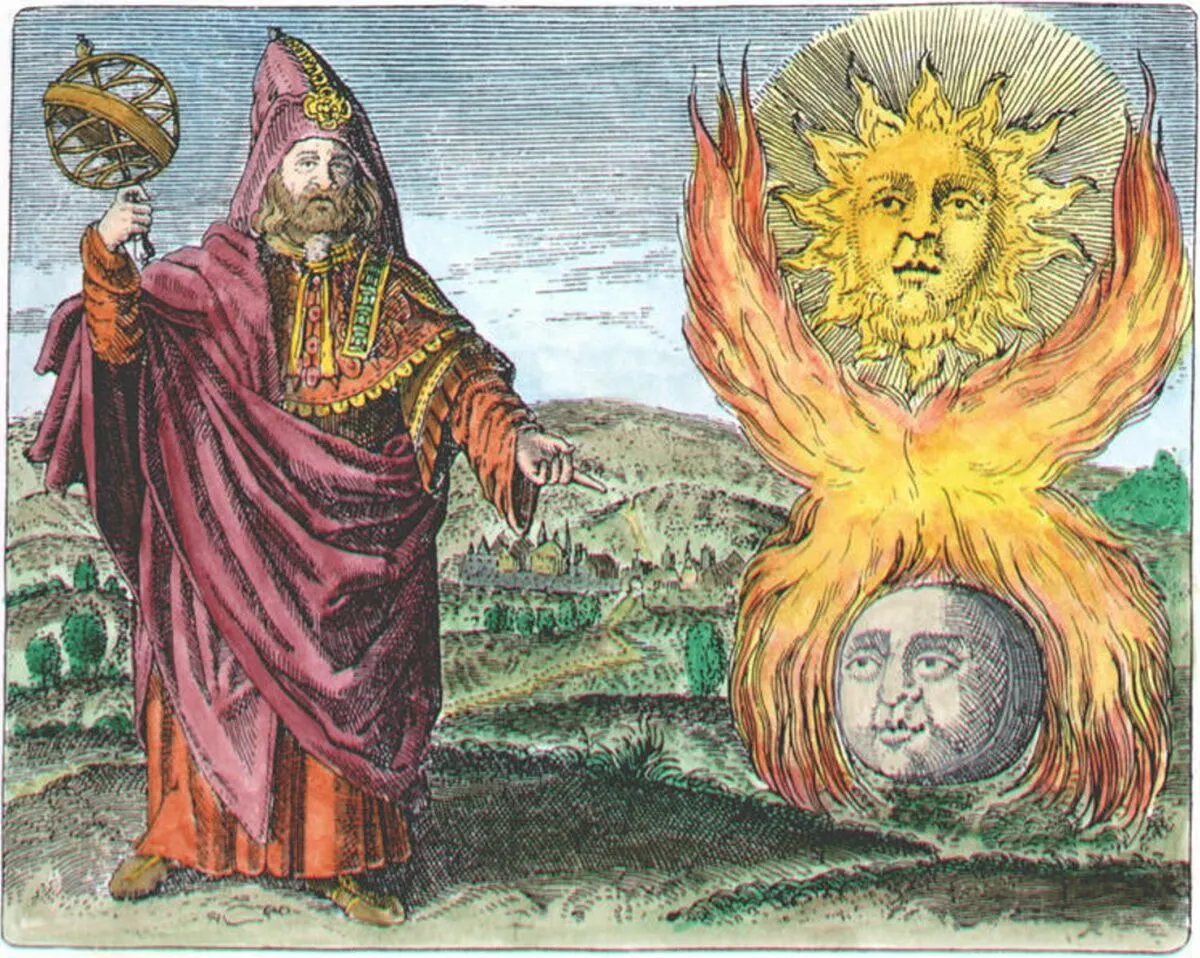
The alchemists ostensibly sought the Stone of the Wise, a mythical object that would literally transmute lead into gold; or at least, so goes the popular “exoteric” interpretation of their pursuits. Particularly during the time of the Inquisition and fanatic Christianity throughout western Europe, many mystics and spiritual seekers who sought additional depth to their study that extended beyond that which their soporific gospel sermons could provide, began to explore a complex of ideas that extends to time ahistorical and has managed to survive, to present day, mostly intact, though obscured and obfuscated. Naturally however, under the prying eyes of the Church, such heresies, sometimes in contravention of Church dogma and doctrine, were not to be tolerated, and even ought to be punishable by death. Thus the emergence of the esoteric style of literature, in which multiple meanings are hidden and intentionally made ambiguous such that two meanings may be communicated to two disjoint sets of audience: the initiates, who understood the esoteric definitions of the language and terms used, and those who understood the exoteric definitions in common circulation.
What does this mean for our alchemical ancestors? Exoterically, they sought the transmutation of lead into gold; esoterically, this was in fact an allegory for the transmutation of the base, unenlightened animal consciousness, into the fully enlightened, rational, self-directed, “free willed” egoic consciousness of modern man. This transformation is assigned many names, in many different languages, by many different cultures; enlightenment, union with God, divine inspiration, the influence of the genius from Roman mythology, communion with the soul, the “flow state.” Irrespective of the language you use to refer to what I describe, we can observe one commonality: the existence of something else, that extends beyond the magisterium of matter and panentheistically beyond into the world of ideas.
A word now on scientific materialism; I received enough scientific education to understand the viewpoint that our day to day, waking, conscious experience is an emergent phenomenon that arises from the immense complexity of the brain and its combinatorial explosion of neuronal interconnections. I in fact agree with this point of view; there is indeed nothing but matter, and metaphysical notions of “souls” made of “energies” and other “quantum woooOoooOoOoooOOOOOos” may be swiftly dispensed by Occam’s Razor... but what about minds? Can it not be said, that when one enters into the dream world every night, that they commune with the immaterial, the mental, the ethereal, perhaps, even, the “spiritual?” What does this word even mean? And what of the mathematician, when he enters his waking daydream, and retreats into a purely mental and logical world of syllogism, and modus tollens, of Platonic forms and solids, of definition and theorem and proof (lemmata left aside for the time being)? Is the mathematician merely cogitating on chemical actuators and action potentials?
Arguably, yes; but only in the same way that Google Chrome, and this website, are “only zeros and ones.” In some ultimately reductionist sense this is in fact true; yet nobody would dare to program something like Chrome, in all of its million of lines of “glory,” using only zeros and ones. Instead, what software developers do, is they paper an “abstraction” over the zeros and ones - if you squint a little bit, these zeros and ones actually form the text “hello,” and these zeros and ones actually form this popup modal asking you to subscribe, and let’s actually just forget talking about the zeros and ones directly and rather, talk about the higher-order things they represent.
So, what is the higher-order thing that the neurons and neurotransmitters of your brain represent? Is it perhaps nothing at all? This is an acceptable answer, and perhaps the one most palatable to those of an orthodox scientific inclination. Yet this somehow feels unsatisfying; as if the computer in Searle’s “Chinese Room” truly understood “Chinese,” despite merely following a “chatbot cookbook” procedure: if this, then that; else, the other.
Searle said the computer lacked “intentionality;” its words could not “refer to” or be “about” anything - they were merely the result of a machine spinning its gears and cranking out a result from the pure determinism of its design. After all, how can one say that a machine can refer to the complexity of a human emotion? When a human tells you, “I’m happy,” or, “I’m sad,” or, “I’m scared,” we operate under the presumption - perhaps even the delusion - that there is a real human being, actually having those experience behind those words. Not a bot. Not a machine. Not Searle’s “Chinese Room,” but a real human, experiencing joy, or melancholy, or terror. These words have intentionality about some profound aspect of human experience that machines and LLMs do not.
“All Western faith and good faith became engaged in this wager on representation: that a sign could refer to the depth of meaning, that a sign could be exchanged for meaning and that something could guarantee this exchange - God of course.”
- Jean Baudrillard, “Simulacra and Simulation,” 1981.
Let us return then to our present query: what is it that your brain represents? Having dispensed with strict monistic materialism for now, if only temporarily, let us now turn to the great granddaddy of dualism himself, René Descartes:
“[...] to speak accurately I am not more than a thing which thinks, that is to say a mind or a soul, or an understanding, or a reason, which are terms whose significance was formerly unknown to me.”
- Rene Descartes, “Meditations on First Philosophy,” 1642, Internet Encyclopedia of Philosophy, 1996, translated by Elizabeth S. Haldane.
What is going on here? Why is Descartes putting those two words together so closely, and in fact equating them in terms of the singular thing to which they refer: a thing that thinks? Here is the first key to understanding the esotericists: the soul is the mind, the mind is the soul; whenever you read any spiritual or religious or esoteric text, in order to read it aright, know this: they were always talking about things that only exist in your head. When Moses saw the burning bush in the desert - was it really on fire? Was he simply tripping balls? Does it in fact matter? The mere fact that, given some sensory input, perhaps exogenous, perhaps endogenous (perhaps, even, with chemical assistance), Moses had a profound internal experience that radically altered his relationship to his outside world, and indeed, his entire reality. That is what matters; the fact that a real human had a real profound experience, in a way a machine cannot. This is what distinguishes man from the machine; and if we are to find a way to differentiate ourselves from LLMs in the age of AI, we had best begin understand what is going on, right inside ourselves.
More to come whenever the moment arises.